
Back to Home Page
On celebrating boats ...
The Society of Friends, a community of pacifist British Quakers living near London, were made aware by Tolstoyan emigres also living nearby, of the dire circumstances of the persecuted Doukhobors in the Russian Caucasus in the late 1890s. The Friends felt it their moral and humanitarian responsibility to do what they could to help alleviate their suffering, concluding it could be done by finding them refuge overseas. The Friends funded an initial Doukhobor migration to Cyprus and then contributed to the transatlantic migration to Canada.
Convinced of the worthiness of their cause, certain members of the group likened the Doukhobor emigration to the flight of the Pilgrim Fathers from England and the Netherlands to North America in 1620. And there were indeed arguable similarities, in circumstance and practicality. Both groups were separatists in their own way, and each made use of two ocean-going vessels for their journey, the Doukhobors on the steamships Lake Huron and Lake Superior, and the Pilgrim Fathers on two sailing ships, the Mayflower and the Speedwell. The sailing ships were, of course, wooden, and the sister ship, didn't "speedwell" at all. Springing a leak part way into the voyage on two separate occasions, it was forced to return to seaport for repairs and was ultimately abandoned, and the seafaring pilgrims huddled together on the Mayflower to complete their voyage. The iron Beaver Line steamships fared much better, and there was no need to glorify or celebrate them like the heroic Mayflower, beyond recognizing their historic role in the transatlantic Doukhobor migration. Nonetheless, the two steamships have over time, seemingly acquired a life of their own, achieving a degree of symbolic importance in the historiography of the Doukhobor experience and their exodus to Canada.
The existing photographs ...
There are fortunately many surviving photographs of the historic Doukhobor sea voyages, picturing the emigrants on board these vessels. One such set was created by William Bellows, a representative of the Quaker British Society, who travelled with the Doukhobors from Cyprus to Quebec on the SS Lake Superior in 1899, creating possibly the best selection of images to illustrate such a voyage. Many of his photographs later appeared in a book by an American Quaker fellow sympathiser, Joseph Elkinton.
Doukhobor immigrants on the SS Lake Superior in the St. Lawrence River, near Quebec in 1899.
These photos are from a series taken by William Bellows, who accompanied them from Cyprus on the third transatlantic Doukhobor voyage. These on- deck photographs later appeared in two well-illustrated books by Canadian historian and author, Koozma J. Tarasoff: A Pictorial History of the Doukhobors, Saskatoon, Sask.: Prairie Books Dept., the Western Producer, 1969, 280 pp. and, Plakun Trava — The Doukhobors, Grand Forks, BC: MIR Publications Society, 1982, 271 pp. Many of Tarasoff's photographs can now be found in the BC Provincial Archives, although their provenance prior to their acquisition by the archive, is unknown.


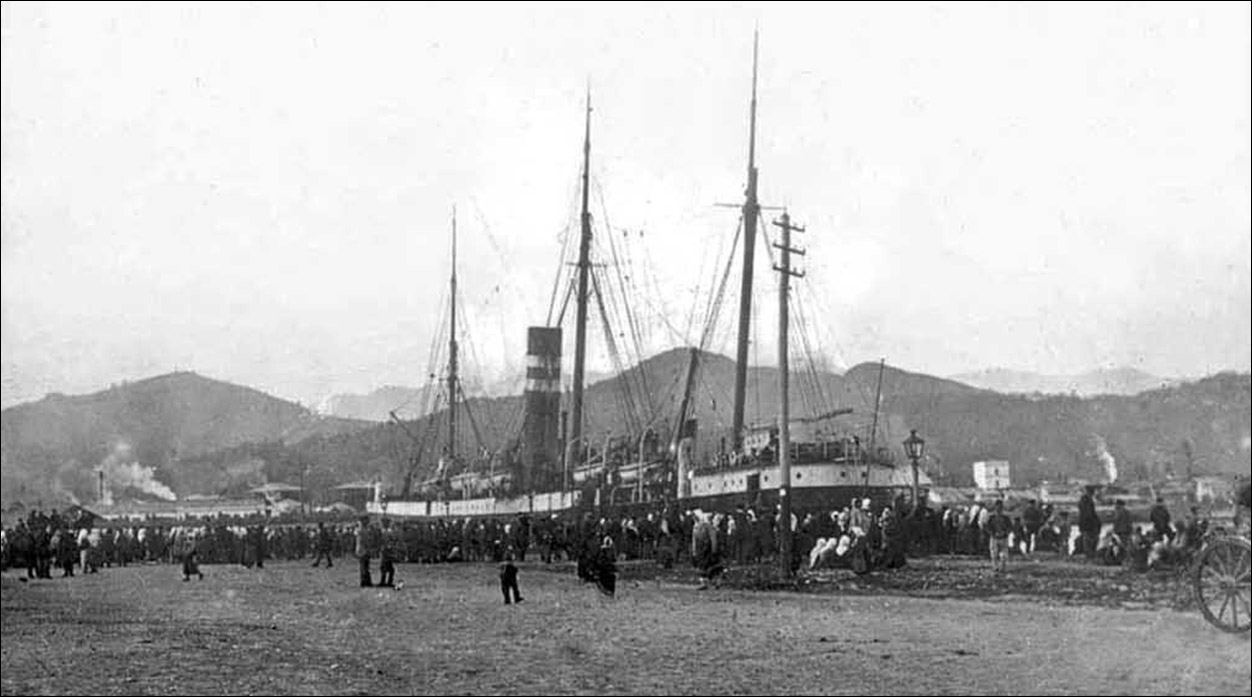
Aside from deck scenes such as these, there are however very few photographs that offer researchers a good full-profile visual representation of the two iconic Beaver Line steamships themselves. The two following images (by unknown photographers) likely come closest in that respect. They depict the Doukhobor departure from the Caucasus at the port city of Batum, on the eastern seacoast of the Black Sea. The emigrants are seen here boarding the SS Lake Huron, in readiness for the first of four transatlantic Doukhobor voyages in the winter of 1899. The logistics of this voyage, including the procurement of the ships themselves from Liverpool, was orchestrated by Tolstoyan friend, Leopold Sulerzhitsky, who accompanied them overseas on this boat.
Two existing photographs depict the SS Lake Huron docked аt the Batoum harbour оп the Black Sea in 1899, loading Doukhobor emigrants оп their way to Canada.
Aside from their unique flags, the steamships of the Beaver Line fleet are distinguished by their single black funnels, capped with two yellow stripes, shown here in white and evident in both images. The lower photograph appears in the book, Sergej Tolstoy and the Doukhobors: А Joumey to Canada, Diary and Correspondence. - photographers unknown.

Victor Stevenson and the Beaver Line photographs ...
After many fruitless efforts to locate additional quality images of the steamships online, two excellent marine photographs were finally found "offline" in consultation with an unexpected source, who as it turned out, had the necessary credentials and the enthusiasm to accomplish the task.
When he was approached, Victor Stevenson was a retired school teacher and vice-principal with the Vancouver School District. But he also had a unique military background, serving in various capacities and ranks with the 15th Field Artillery Regiment in Vancouver, B.C. for more than three decades. Keenly interested in history at large, including that of the Doukhobors, he was inspired to initiate the development of a military Regimental Museum close to home in 1988, and was recognized for this work by his appointment as Honorary Lieutenant-Colonel of the Regiment.
A number of years later, the museum became involved in the restoration of the old Point Grey WWII coastal artillery battery at the University of British Columbia (UBC), on the current site of the Museum of Anthropology (MOA). (Link) On one occasion, this writer spoke to Victor on this matter, learning that the museum had embarked on a quest for documents and an artifact, and more specifically, a 6 inch artillery piece that had gone missing from the battery after the Second World War. There however appeared to be a suitable replacement found in England, and negotiations were underway regarding an acquisition, possibly entailing a personal visit. This same writer offhandedly raised the possibility that this might also be a good opportunity to investigate a potential source for photographs of the Beaver Line steamships, which were known to have a Liverpool connection.
The casual and undoubtedly presumptuous comment was not expected to be taken seriously, until it was proven otherwise, when an oversized brown envelope arrived in the mail a month or so later, with two 8x10 inch, high quality paper prints of the SS Lake Huron and SS Lake Superior. These were gifted, and other than a brief comment that the photographs were acquired from a maritime museum in the United Kingdom, their specific source was not revealed at that time, and sadly Victor Stevenson died unexpectedly in 2010. It is unclear whether these photographs were purchased directly from a museum, or otherwise purchased by mail, but their donation was a kind gesture on his part and was a unique and much appreciated contribution to the Canadian Doukhobor community and the story of the Canadian migration. Many other remaining photographs of Doukhobor interest from the Stevenson family collection, were likewise posthumously donated, and will be archived or put to use.


Victor Stevenson's SS Lake Huron and SS Lake Superior photos were later colourized and adapted to simulate marine postcards in 1998, to mark the 100th Anniversary of the Doukhobor Immigration to Canada, the prints to be distributed locally as complementary gifts and community fund raisers. Brief statistical details of the steamships and their registered owners, gleaned from the Bonsor volumes, known to be a respected source for these sorts of matters, were included with the prints. (Link)

With additional research on this subject, a virtually identical copy of the Stevenson SS Lake Huron photograph, and a copy of this colourized version of the SS Lake Superior, were found online on another website dedicated to the task of preserving the history and associated statistics of steamships built on the River Clyde. (Link)
Under development by volunteers, the website looks to be a promising resource, and includes two additional significant prints of interest rarely seen elsewhere. The first of these, a predecessor of the SS Lake Superior, is an 1868 photograph of the Beaver Line three-masted, iron-hulled, Lake Superior barque, docked at Greenock near the mouth of the River Clyde.

The second is of greater interest ... a previously unknown photograph of the SS Lake Huron, depicting a clear full-profile view of its port side, dated 1881, with seemingly one or two service vessels or steam tugs at its side. The landing dock is unfortunately not identified.

The SS Lake Huron, a rare 1881 port-side view.
The ship was built in that year for the Canada Shipping Co. Ltd., Liverpool, by the London & Glasgow Engine and Iron Ship Building Co. Ltd. at the Middleton Yard at Govan, on the River Clyde near Glasgow. The ship ran under he Beaver Line in 1899 from Liverpool to Canada and elsewhere.
The W.H. Yorke painting of the SS Lake Superior ...
This look at marine photographs will conclude with an unusual image of the SS. Lake Superior, which is both a photograph and a painting, with its own short history.Both of the Yorkes, the father, William Gay, and the son, William Howard, were ship portraitists, from St. John, New Brunswick, the father also being an actual shipwright there at one time. The younger, William Howard Yorke, moved to Liverpool where he maintained a career as a marine artist, his paintings becoming recognized worldwide for their detail and authenticity. The artist is seen below next to a black and white photograph of his painting of the S.S. Lake Superior, 1885, taken in 1938 by the prestigious Wm. Notman & Son Montreal studio. The studio itself had a good reputation, and as we have seen on a previous web page, was employed by the Granby company to travel as far west as Phoenix, British Columbia, thirty years prior, to photograph Phoenix Granby mining operations. (Link)

Prints of the Notman photograph are available from the Montreal McCord Museum and a digitized copy was used to create a colourized simulation of the W.H. Yorke painting, while attempting to preserve the styling of his other marine paintings seen online. The colourized image is used in this web page header, and an enlarged copy of the image itself appears below. An interesting comparison can be made on this web page between the depiction of the SS Lake Superior in the photo-painting, and the source of the Stevenson postcard image above, suggesting that the latter, may indeed have been used by W.H. Yorke himself, as a reference in the creation of his own painting.
The image below is now seen elsewhere online, and this web page will hopefully clarify its origin. This is not a digitized copy of a colourful painting, but it is rather a colourized digital copy of a black and white photograph.
